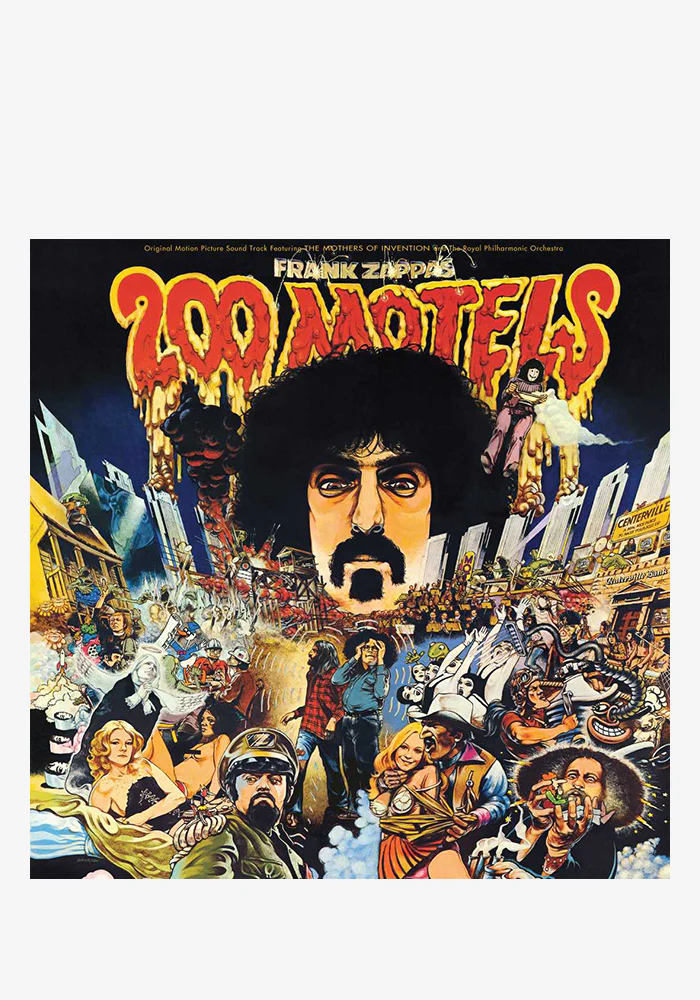
Soundtrack - 200 Motels 50th Anniversary 2LP
Released in October 1971, Frank Zappa’s “200 Motels” was a miraculous feat, a cinematic collision of the venerated musician and composer’s kaleidoscopic musical and visual worlds that brought together Zappa and his band, The Mothers, Ringo Starr as Zappa – as “a large dwarf” – Keith Moon as a perverted nun, Pamela Des Barres in her acting debut, noted thespian Theodore Bikel, the Royal Philharmonic Orchestra, and an incredible assortment of characters (both on screen and off) for a “surrealistic documentary” about the bizarre life of a touring musician. A heady, psychedelic stew of low and high brow art forms, the film, written by Zappa and co-directed by him and Tony Palmer, mixed together irreverent comedic skits, madcap satire, eye-popping animation and virtuosic on-screen musical performances from both The Mothers and the RPO for a fascinating and free-wheeling multimedia extravaganza. Shot in just 10 days with a budget of around $650,000 from distributor United Artists, “200 Motels” was one of the first movies to be filmed entirely on videotape and Zappa and crew pushed the envelope of the burgeoning new medium’s possibilities, mostly notably through its use of spectacular – and at the time – state-of-the-art visual effects. Described by Zappa as “at once a reportage of real events and an extrapolation of them… other elements include ‘conceptual by-products’ of the extrapolated ‘real event’ … In some ways the contents of the film are autobiographical,” “200 Motels” was hailed by the Los Angeles Times as a “a stunning achievement” with “just the right touch of insanity,” and the “Zaniest piece of filmusical fantasy-comedy since The Beatles' ‘A Hard Day's Night’” by Daily Variety.
The music, and its corresponding soundtrack, was equally diverse, a wild pastiche of avant garde rock and orchestral compositions interspersed with dialog from the film. Up until that time, compositions like the finale piece, “Strictly Genteel,” were some of the most ambitious material ever written and recorded by Zappa. The band in the film and on the soundtrack consisted of Frank Zappa (guitar & bass), Mark Volman (vocals & special material), Howard Kaylan (vocals & special material), Ian Underwood (keyboards & winds), Aynsley Dunbar (drums), George Duke (keyboards & trombone), Martin Lickert (bass), Jimmy Carl Black (vocals), and Ruth Underwood (orchestra drum set), not to mention the aforementioned Royal Philharmonic Orchestra. In true Zappa fashion as he wrote in the album’s original liner notes, “This music is not in the same order as in the movie. Some of this music is in the movie. Some of this music is not in the movie. Some of the music that’s in the movie is not in the album. Some of the music that was written for the movie is not in the movie or the album. All of this music was written for the movie, over a period of 4 years. Most of it (60%) was written in motels while touring.”
Putting together this 50th anniversary edition was a labor intensive process that bore fruit at nearly every turn as Travers dug through Zappa’s expansive archives to put together this exhaustive edition. As Travers writes in the liners, “During this search and seizure mission, I was able to unearth a multitude of audio treasures from a very large number of tapes. Original demos, session outtakes, alternate mixes and versions, and even dialog reels that captured an edit of the film that predates the final assembly which eventually made it to theaters everywhere in 1971.” Amongst the gems discovered include a number of ¼-inch reel-to-reel tapes that were made at Trident Studios during February of ’71, which contain rough mixes of nearly everything that was recorded on multi-track. As Travers explains, “they reflect raw performances, as they happened before FZ would get a hold of the multi-track masters and bring them to Whitney Studios in Glendale for over-dubs and sweetening. The Trident tapes allow us to hear music that did not make the film, or the final soundtrack album. They also helped us to reconstruct pieces of music like ‘The Pleated Gazelle’ or ‘What’s The Name Of Your Group?’ into their full sequences per the score. Over the years, even Frank himself forgot the sheer amount of music that actually did get recorded. All of the archiving for this 50th Anniversary set has produced incredible amounts of content that we would never had known existed otherwise.”
Product Information
Product Information
Shipping & Returns
Shipping & Returns
Description
Released in October 1971, Frank Zappa’s “200 Motels” was a miraculous feat, a cinematic collision of the venerated musician and composer’s kaleidoscopic musical and visual worlds that brought together Zappa and his band, The Mothers, Ringo Starr as Zappa – as “a large dwarf” – Keith Moon as a perverted nun, Pamela Des Barres in her acting debut, noted thespian Theodore Bikel, the Royal Philharmonic Orchestra, and an incredible assortment of characters (both on screen and off) for a “surrealistic documentary” about the bizarre life of a touring musician. A heady, psychedelic stew of low and high brow art forms, the film, written by Zappa and co-directed by him and Tony Palmer, mixed together irreverent comedic skits, madcap satire, eye-popping animation and virtuosic on-screen musical performances from both The Mothers and the RPO for a fascinating and free-wheeling multimedia extravaganza. Shot in just 10 days with a budget of around $650,000 from distributor United Artists, “200 Motels” was one of the first movies to be filmed entirely on videotape and Zappa and crew pushed the envelope of the burgeoning new medium’s possibilities, mostly notably through its use of spectacular – and at the time – state-of-the-art visual effects. Described by Zappa as “at once a reportage of real events and an extrapolation of them… other elements include ‘conceptual by-products’ of the extrapolated ‘real event’ … In some ways the contents of the film are autobiographical,” “200 Motels” was hailed by the Los Angeles Times as a “a stunning achievement” with “just the right touch of insanity,” and the “Zaniest piece of filmusical fantasy-comedy since The Beatles' ‘A Hard Day's Night’” by Daily Variety.
The music, and its corresponding soundtrack, was equally diverse, a wild pastiche of avant garde rock and orchestral compositions interspersed with dialog from the film. Up until that time, compositions like the finale piece, “Strictly Genteel,” were some of the most ambitious material ever written and recorded by Zappa. The band in the film and on the soundtrack consisted of Frank Zappa (guitar & bass), Mark Volman (vocals & special material), Howard Kaylan (vocals & special material), Ian Underwood (keyboards & winds), Aynsley Dunbar (drums), George Duke (keyboards & trombone), Martin Lickert (bass), Jimmy Carl Black (vocals), and Ruth Underwood (orchestra drum set), not to mention the aforementioned Royal Philharmonic Orchestra. In true Zappa fashion as he wrote in the album’s original liner notes, “This music is not in the same order as in the movie. Some of this music is in the movie. Some of this music is not in the movie. Some of the music that’s in the movie is not in the album. Some of the music that was written for the movie is not in the movie or the album. All of this music was written for the movie, over a period of 4 years. Most of it (60%) was written in motels while touring.”
Putting together this 50th anniversary edition was a labor intensive process that bore fruit at nearly every turn as Travers dug through Zappa’s expansive archives to put together this exhaustive edition. As Travers writes in the liners, “During this search and seizure mission, I was able to unearth a multitude of audio treasures from a very large number of tapes. Original demos, session outtakes, alternate mixes and versions, and even dialog reels that captured an edit of the film that predates the final assembly which eventually made it to theaters everywhere in 1971.” Amongst the gems discovered include a number of ¼-inch reel-to-reel tapes that were made at Trident Studios during February of ’71, which contain rough mixes of nearly everything that was recorded on multi-track. As Travers explains, “they reflect raw performances, as they happened before FZ would get a hold of the multi-track masters and bring them to Whitney Studios in Glendale for over-dubs and sweetening. The Trident tapes allow us to hear music that did not make the film, or the final soundtrack album. They also helped us to reconstruct pieces of music like ‘The Pleated Gazelle’ or ‘What’s The Name Of Your Group?’ into their full sequences per the score. Over the years, even Frank himself forgot the sheer amount of music that actually did get recorded. All of the archiving for this 50th Anniversary set has produced incredible amounts of content that we would never had known existed otherwise.”