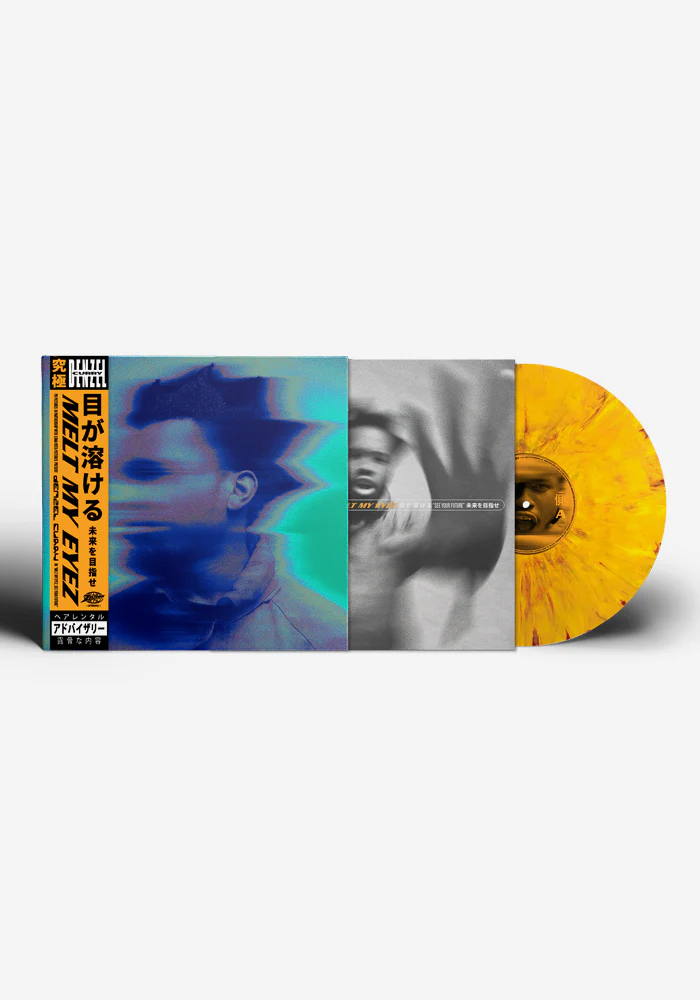
Melt My Eyez Exclusive LP
A Newbury Comics exclusive color vinyl pressing.
Denzel Curry’s new album Melt My Eyes, See Your Future is the sound of the mercurial Miami rapper leveling up. “This is my green lightsaber moment!” beams the 26-year-old, likening his evolution on this record to Luke Skywalker’s in Star Wars not just because it’s a record full of cinematic scope (anime and Akira Kurosawa are among its chief influences) but because he now no longer feels like a hothead apprentice. On each of the fourteen sumptuous tracks here, Denzel is operating with the force of a full Jedi master, slicing through bars with a dexterity, magic and control that would make Yoda blush.
“It’s my best album, period,” insists the rapper, who went through intense personal lows to create this dazzling career high-point. “I won’t lie, the last few years in the pandemic have been hard. When quarantine hit, I suddenly realised I was always distracted before. I never sat with myself. I never got to deal with my problems for real.” On Melt My Eyes, See Your Future, those problems are processed in brave, boundary-breaking detail.
To his growing legions of fans, the intrepid soul-searching of this record will come as no surprise – after all, Curry’s music has always been confessional. “You have to feel it to fuck with it,” as he puts, reciting the mantra he carries with him every time he steps up to a microphone, a reminder to himself that there’s no substitute for raw emotion. “Being honest in my music, that’s how it’s meant to be. What else is there if I don’t have that? Distressed, happy, mad – I channel it all into my music, ‘cos that's all I know.”
When it came to Melt My Eyes, See Your Future, though, Denzel challenged himself to cut closer to the bone than he (or any of his peers, for that matter) have ever dared previously. From tracks like its eponymous opener, on which he pain-stakingly explores his own sex addictions, to the more outward-facing John Wayne, which addresses “gun violence in America and my community,” this is hip-hop truth-telling at its finest and most potent.
Getting to this point, however, hasn’t come easy. Since his breakout mixtape King Remembered Underground Tape 1991–1995 began him on this path towards blockbuster success, Denzel may have grown to become one of the most respected and technically dextrous MCs in rap today, lauded by everyone from Pitchfork to the New York Times.
Barely a decade ago, however, he was an art school dropout battling brutal depression. “I remember feeling like I didn’t want to live,” the star recalls, describing a crossroads in his life in which “everything was happening at once. I got kicked out of school, my mother and father separated, and that really broke me.” It was at this point that he threw everything into music, in search of a sense of purpose, recording rough raps on a microphone bought from Best Buy on his fifteenth birthday.
Soon, Denzel went from being influenced by local rap heroes like SpaceGhostPurrp to collaborating with them, joining the influential Carol City collective Raider Klan. He quickly began to amass an army of fans, many of whom were surprised to discover his tender age. Denzel had grown up in a creative household, raised by a truck driver dad who taught him to draw comics and a retired musician mother. As a result, he had prodigious talents that exceeded those of any 16-year-old most of us have ever met. “People would ask if I’m coming to the club after a show,” he laughs. “I’d be like, bro, I’m in eleventh grade!”
When a dispute forced him out of the group in 2013, he threw everything into carving his own name into rap history – and no longer just in the Florida scene. The outcome of this determination was Nostalgia 64 – a pulverising mixtape that put his name well and truly on the map. “I like proving people wrong. That’s my thing. It had really hurt, what happened with the Klan, so I went stupid making it the best it could be,” he says. Denzel recorded the album “half sober, half on acid and weed,” and quickly found its intoxicating cocktail of take-no-prisoner flows and smoky production striking a chord with rap fans across the US – including a certain Earl Sweatshirt. “When Earl tweeted about me, that's what I was like, “oh shit, it's time!” I remember being so excited, thinking: “can I get on a song?” I told all my fans to tweet at him asking and he just blocked me,” he laughs. The pair are good friends today.
Then, tragedy struck. In 2014, Denzel’s brother Treon Johnson died after being tasered by police. “I was in the middle of making a beat when I got the call. I just couldn’t believe it,” says Denzel. He’d had a first-hand taste a few years earlier of how the epidemic of American violence towards young Black men could devastate families and impact communities: Denzel had gone to school with Tryavon Martin, the Miami Gardens teenager shot by George Zimmerman in 2012. “Now it was happening in my family. That took a blow. I really was not there mentally.” There was surrealness as well as sorrow in the wake of his sibling’s death, which occurred as his career was going from strength to strength: “I remember having to fly to Texas to play SXSW. All I could think about was having to bury my brother.”
It was at that point that, arguably, the Denzel Curry we know today was born. Denzel dealt with his pain the only way he could – by raging over boisterous beats on anthems like 2015’s Ultimate, and soul-searching over sparse piano on tracks like Speedboat, from 2019’s acclaimed ZUU LP. State-of-the-nation insights on police brutality and inner glimpses at his own grief began to fill celebrated release after celebrated release, as Denzel’s star continued to rise. Finally, one day at the end of 2014, he found “hope at the end of the tunnel.” That was the day he met Andre 3000.
It was a meeting orchestrated by Denzel’s manager, Mark Maturah, and it made an important imprint on the rising rapper. “I remember asking him a couple of questions, because I figured this might be the only time I could talk to this dude. I asked him: “why you keep changing your sound on every album? What makes you experiment with different types of music?” And you know what? He gave me the simplest answer,” laughs Denzel. “He told me: “I was bored.” That’s the key to being an artist. Never let yourself get bored.”
Ever since, Denzel has been living out Andre’s advice. Whether linking with Kenny Beats on 2020’s Unlocked collaborative album or covering Rage Against The Machine in radio sessions (because why the hell not), he strives to be impossible to pin down musically.
No wonder, then, that he’s struck up such a close friendship with another artist who seeks to blur the borders between genres – Billie Eilish, who personally chose Denzel to open for her on her arena tour in 2018. In fact, the Bad Guy hit-maker is such a fan of Denzel, she once went against her label by recording and promoting an illegal collaboration between the pair. “She’s like a sister,” grins Denzel. “I remember she came to the studio and laid down vocals for Sirens, which is a song that's on [2018 album] TA13OO. Her label said we couldn't use her as a credited feature. So she went against her label. When the song dropped, she was like: “Hey everyone, here’s this song I’m on!”
Packing out arenas with Billie was an experience that informed what Denzel planned to do next. “When I saw how the crowd was reacting to Ultimate and songs like that in a stadium setting like that, it just made me think: “yo, I could do this!” It was like when Kanye West went on tour with U2 and that's what influenced Graduation. It changed my psychology,” he says. “I realised I need songs that big crowds will react to, and sounds that will generate a certain response.”
Which brings us to the next era of Denzel Curry, closing one decade and marking the beginning of another, in the exciting career of a rap game innovator. Recorded in Los Angeles, with records by The Soulquarians on repeat and the one and only Thundercat in the studio alongside him, Melt My Eyes, See Your Future finds Denzel looking deep in the mirror. “I sat down with myself and I began to ask: when nobody's around telling you “you're this, you're that,” exactly who are you? This whole album is a search for who I really am.”
Its highlights are many: Mental, which Denzel wrote while battling a bout of Covid-19, rapping through raspy breaths and fatigue, is an addictive delight, while Troubles, a collaboration with auto-tune icon T-Pain, is as Denzel puts it, “a motherfucking hit!”
With Kid Cudi producer Dot Da Genius and Boi1da among the album’s other collaborators, it’s a record, as previously mentioned, deeply influenced by martial arts and world cinema. “I was watching the Akira Kurusawa documentary Toshiro Mifune: The Last Samurai, and the idea of samurai culture heavily inspired me. I want to be a force for positivity who went through struggle to be the warrior I am today.”
There are “no tracks where I’m yelling. This time, I’m speaking,” Denzel explains. “I’m articulating my emotions better than ever before.” A lot of things have changed since the rap multi-hyphenate began blazing his trail in music. His dedication to emotional honesty isn’t one of them, however. After all, “you have to feel it to fuck with it,” as the rapper always says. On Melt My Eyes, See Your Future, that’s truer than ever before.
Product Information
Product Information
Shipping & Returns
Shipping & Returns
Description
A Newbury Comics exclusive color vinyl pressing.
Denzel Curry’s new album Melt My Eyes, See Your Future is the sound of the mercurial Miami rapper leveling up. “This is my green lightsaber moment!” beams the 26-year-old, likening his evolution on this record to Luke Skywalker’s in Star Wars not just because it’s a record full of cinematic scope (anime and Akira Kurosawa are among its chief influences) but because he now no longer feels like a hothead apprentice. On each of the fourteen sumptuous tracks here, Denzel is operating with the force of a full Jedi master, slicing through bars with a dexterity, magic and control that would make Yoda blush.
“It’s my best album, period,” insists the rapper, who went through intense personal lows to create this dazzling career high-point. “I won’t lie, the last few years in the pandemic have been hard. When quarantine hit, I suddenly realised I was always distracted before. I never sat with myself. I never got to deal with my problems for real.” On Melt My Eyes, See Your Future, those problems are processed in brave, boundary-breaking detail.
To his growing legions of fans, the intrepid soul-searching of this record will come as no surprise – after all, Curry’s music has always been confessional. “You have to feel it to fuck with it,” as he puts, reciting the mantra he carries with him every time he steps up to a microphone, a reminder to himself that there’s no substitute for raw emotion. “Being honest in my music, that’s how it’s meant to be. What else is there if I don’t have that? Distressed, happy, mad – I channel it all into my music, ‘cos that's all I know.”
When it came to Melt My Eyes, See Your Future, though, Denzel challenged himself to cut closer to the bone than he (or any of his peers, for that matter) have ever dared previously. From tracks like its eponymous opener, on which he pain-stakingly explores his own sex addictions, to the more outward-facing John Wayne, which addresses “gun violence in America and my community,” this is hip-hop truth-telling at its finest and most potent.
Getting to this point, however, hasn’t come easy. Since his breakout mixtape King Remembered Underground Tape 1991–1995 began him on this path towards blockbuster success, Denzel may have grown to become one of the most respected and technically dextrous MCs in rap today, lauded by everyone from Pitchfork to the New York Times.
Barely a decade ago, however, he was an art school dropout battling brutal depression. “I remember feeling like I didn’t want to live,” the star recalls, describing a crossroads in his life in which “everything was happening at once. I got kicked out of school, my mother and father separated, and that really broke me.” It was at this point that he threw everything into music, in search of a sense of purpose, recording rough raps on a microphone bought from Best Buy on his fifteenth birthday.
Soon, Denzel went from being influenced by local rap heroes like SpaceGhostPurrp to collaborating with them, joining the influential Carol City collective Raider Klan. He quickly began to amass an army of fans, many of whom were surprised to discover his tender age. Denzel had grown up in a creative household, raised by a truck driver dad who taught him to draw comics and a retired musician mother. As a result, he had prodigious talents that exceeded those of any 16-year-old most of us have ever met. “People would ask if I’m coming to the club after a show,” he laughs. “I’d be like, bro, I’m in eleventh grade!”
When a dispute forced him out of the group in 2013, he threw everything into carving his own name into rap history – and no longer just in the Florida scene. The outcome of this determination was Nostalgia 64 – a pulverising mixtape that put his name well and truly on the map. “I like proving people wrong. That’s my thing. It had really hurt, what happened with the Klan, so I went stupid making it the best it could be,” he says. Denzel recorded the album “half sober, half on acid and weed,” and quickly found its intoxicating cocktail of take-no-prisoner flows and smoky production striking a chord with rap fans across the US – including a certain Earl Sweatshirt. “When Earl tweeted about me, that's what I was like, “oh shit, it's time!” I remember being so excited, thinking: “can I get on a song?” I told all my fans to tweet at him asking and he just blocked me,” he laughs. The pair are good friends today.
Then, tragedy struck. In 2014, Denzel’s brother Treon Johnson died after being tasered by police. “I was in the middle of making a beat when I got the call. I just couldn’t believe it,” says Denzel. He’d had a first-hand taste a few years earlier of how the epidemic of American violence towards young Black men could devastate families and impact communities: Denzel had gone to school with Tryavon Martin, the Miami Gardens teenager shot by George Zimmerman in 2012. “Now it was happening in my family. That took a blow. I really was not there mentally.” There was surrealness as well as sorrow in the wake of his sibling’s death, which occurred as his career was going from strength to strength: “I remember having to fly to Texas to play SXSW. All I could think about was having to bury my brother.”
It was at that point that, arguably, the Denzel Curry we know today was born. Denzel dealt with his pain the only way he could – by raging over boisterous beats on anthems like 2015’s Ultimate, and soul-searching over sparse piano on tracks like Speedboat, from 2019’s acclaimed ZUU LP. State-of-the-nation insights on police brutality and inner glimpses at his own grief began to fill celebrated release after celebrated release, as Denzel’s star continued to rise. Finally, one day at the end of 2014, he found “hope at the end of the tunnel.” That was the day he met Andre 3000.
It was a meeting orchestrated by Denzel’s manager, Mark Maturah, and it made an important imprint on the rising rapper. “I remember asking him a couple of questions, because I figured this might be the only time I could talk to this dude. I asked him: “why you keep changing your sound on every album? What makes you experiment with different types of music?” And you know what? He gave me the simplest answer,” laughs Denzel. “He told me: “I was bored.” That’s the key to being an artist. Never let yourself get bored.”
Ever since, Denzel has been living out Andre’s advice. Whether linking with Kenny Beats on 2020’s Unlocked collaborative album or covering Rage Against The Machine in radio sessions (because why the hell not), he strives to be impossible to pin down musically.
No wonder, then, that he’s struck up such a close friendship with another artist who seeks to blur the borders between genres – Billie Eilish, who personally chose Denzel to open for her on her arena tour in 2018. In fact, the Bad Guy hit-maker is such a fan of Denzel, she once went against her label by recording and promoting an illegal collaboration between the pair. “She’s like a sister,” grins Denzel. “I remember she came to the studio and laid down vocals for Sirens, which is a song that's on [2018 album] TA13OO. Her label said we couldn't use her as a credited feature. So she went against her label. When the song dropped, she was like: “Hey everyone, here’s this song I’m on!”
Packing out arenas with Billie was an experience that informed what Denzel planned to do next. “When I saw how the crowd was reacting to Ultimate and songs like that in a stadium setting like that, it just made me think: “yo, I could do this!” It was like when Kanye West went on tour with U2 and that's what influenced Graduation. It changed my psychology,” he says. “I realised I need songs that big crowds will react to, and sounds that will generate a certain response.”
Which brings us to the next era of Denzel Curry, closing one decade and marking the beginning of another, in the exciting career of a rap game innovator. Recorded in Los Angeles, with records by The Soulquarians on repeat and the one and only Thundercat in the studio alongside him, Melt My Eyes, See Your Future finds Denzel looking deep in the mirror. “I sat down with myself and I began to ask: when nobody's around telling you “you're this, you're that,” exactly who are you? This whole album is a search for who I really am.”
Its highlights are many: Mental, which Denzel wrote while battling a bout of Covid-19, rapping through raspy breaths and fatigue, is an addictive delight, while Troubles, a collaboration with auto-tune icon T-Pain, is as Denzel puts it, “a motherfucking hit!”
With Kid Cudi producer Dot Da Genius and Boi1da among the album’s other collaborators, it’s a record, as previously mentioned, deeply influenced by martial arts and world cinema. “I was watching the Akira Kurusawa documentary Toshiro Mifune: The Last Samurai, and the idea of samurai culture heavily inspired me. I want to be a force for positivity who went through struggle to be the warrior I am today.”
There are “no tracks where I’m yelling. This time, I’m speaking,” Denzel explains. “I’m articulating my emotions better than ever before.” A lot of things have changed since the rap multi-hyphenate began blazing his trail in music. His dedication to emotional honesty isn’t one of them, however. After all, “you have to feel it to fuck with it,” as the rapper always says. On Melt My Eyes, See Your Future, that’s truer than ever before.